

Few everyday purchases in Canada have climbed in price as steeply as cigarettes. Whether you are a long-time smoker in Toronto, a Québécois searching “combien coûte un paquet de cigarettes au Canada”, or someone who just moved to Vancouver and got sticker shock at the corner store, the question is the same: how much does a pack of cigarettes actually cost in Canada today? The short answer is anywhere from roughly $12 to over $22 CAD for a pack of 20, depending entirely on which province or territory you are standing in when you buy.
This guide breaks down current average prices by province, explains exactly how federal and provincial taxes build up the final price, and shows Canadian smokers how to compare options so they can make smarter decisions about where and how they buy.

Quick Answer: Average Price of a Pack of 20 Cigarettes in Canada
Across the country, the national average for a premium brand pack of 20 sits around $16 to $18 CAD in 2026. A king-size pack of 25 typically costs $19 to $23, and a full carton of 200 cigarettes ranges from about $120 to $180 at retail. Discount or value brands shave a few dollars off those figures, but because taxes make up the majority of the price, the savings are smaller than many smokers expect.
- Cheapest province: Quebec, where a pack of 20 averages $12 – $14
- Most expensive regions: Nunavut and the Northwest Territories, often $20 – $23+
- Largest markets (Ontario, BC, Alberta): roughly $15 – $19 per pack
Cigarette Prices by Province and Territory (2026 Estimates)
The table below shows typical retail price ranges for a standard pack of 20 premium cigarettes, along with the approximate provincial tobacco tax per pack. Figures are averages drawn from convenience stores and gas stations and will vary by brand, retailer, and local promotions.
| Province / Territory | Avg. Price (Pack of 20) | Provincial Tobacco Tax (approx. per pack) | Sales Tax Applied |
|---|---|---|---|
| Quebec | $12.00 – $14.00 | ~$3.78 | GST + QST |
| Ontario | $15.00 – $17.00 | ~$3.70 | HST 13% |
| New Brunswick | $16.00 – $18.00 | ~$4.30 | HST 15% |
| Alberta | $17.00 – $19.00 | ~$6.00 | GST 5% only |
| British Columbia | $17.00 – $19.50 | ~$6.50 | GST (tobacco exempt from PST) |
| Nova Scotia | $17.00 – $19.00 | ~$5.90 | HST 15% |
| Prince Edward Island | $17.00 – $19.00 | ~$5.90 | HST 15% |
| Saskatchewan | $18.00 – $20.00 | ~$5.80 | GST + PST |
| Manitoba | $18.00 – $20.50 | ~$6.00 | GST + RST |
| Newfoundland & Labrador | $18.00 – $20.50 | ~$6.50 | HST 15% |
| Yukon | $18.00 – $20.00 | ~$6.00 | GST 5% |
| Northwest Territories | $20.00 – $22.00 | ~$7.30 | GST 5% |
| Nunavut | $20.00 – $23.00+ | ~$6.00 | GST 5% |
Prices are estimates for informational purposes and change frequently as governments adjust tax rates. Always check your local retailer for current pricing.
Why Cigarette Prices Vary So Much Across Canada
Unlike groceries or gas, where regional differences come mostly from shipping and competition, cigarette prices in Canada are driven almost entirely by tax policy. Every province sets its own tobacco tax rate on top of federal excise duty, and then applies its own sales tax regime. That is why a smoker in Gatineau, Quebec can pay several dollars less per pack than someone just across the river in Ottawa, Ontario.
1. Federal Excise Duty
The federal government charges excise duty on every cigarette manufactured in or imported into Canada. The rate is indexed to inflation each April and has been raised in several recent federal budgets. As of 2026, federal excise duty works out to roughly $3.90 to $4.00 per pack of 20, or close to $40 per carton of 200. You can find the official Canadian cigarette excise tax rates published by the Canada Revenue Agency, including the cigarette tax rates in Canada adjusted for April 2026.
2. Provincial Tobacco Tax
This is where the real gap opens up. Each province applies a per-cigarette tobacco tax ranging from about 18.5 cents in Quebec and Ontario to more than 32 cents in British Columbia and Newfoundland. Over a pack of 20, that difference alone is nearly $3. Provincial governments publish their own rules, such as the Quebec tobacco tax, the Ontario tobacco tax, and the Alberta tobacco tax.
3. Sales Tax (GST, HST, PST, QST)
Finally, sales tax is applied to the already-taxed price. In Atlantic provinces with 15% HST, this adds more than $2 to a pack. Alberta and the territories apply only the 5% GST, which partly offsets their higher tobacco tax. British Columbia exempts tobacco from PST but compensates with one of the highest per-cigarette tobacco taxes in the country.

Breaking Down the Price of a $17 Pack in Ontario
To see how little of your money actually goes toward the tobacco itself, here is a simplified breakdown of a typical $17 premium pack of 20 sold in Ontario:
| Component | Approximate Amount | Share of Price |
|---|---|---|
| Federal excise duty | $3.95 | ~23% |
| Ontario tobacco tax | $3.70 | ~22% |
| HST (13%) | $1.95 | ~11% |
| Manufacturer, wholesaler & retailer | $7.40 | ~44% |
| Total | $17.00 | 100% |
In other words, well over half of what Canadians pay for cigarettes is tax. In high-tax provinces like BC or Newfoundland, the tax share can approach 65% to 70%.
Combien coûte un paquet de cigarettes au Canada ? A Note for Quebec Smokers
Quebec consistently has the lowest cigarette prices in the country, which is why so many francophone smokers searching “combien coûte un paquet de cigarettes au Canada” are surprised to learn how much more their neighbours pay. A pack of 20 in Montreal or Quebec City generally costs between $12 and $14, and a king-size 25 runs about $15 to $17. The province’s lower tobacco tax rate is the main reason, though Quebec has signalled that increases are possible in future budgets. Smokers in Quebec should also note that cross-border purchasing rules and provincial stamp requirements still apply when bringing cigarettes in from other provinces.
How Much Does a Carton of Cigarettes Cost in Canada?
Most regular smokers eventually switch to buying by the carton to save a little per pack. At retail, a carton of 200 (8 packs of 25 or 10 packs of 20) typically costs:
- Quebec: $115 – $135
- Ontario: $140 – $165
- Alberta & BC: $160 – $185
- Atlantic Canada & Prairies: $165 – $195
- Territories: $190 – $220+
For a pack-a-day smoker, that translates to roughly $5,000 to $7,000 per year depending on the province, a figure that has pushed many Canadians to compare brands, switch to value lines, or look for lower-priced ways to buy cigarettes online in Canada.
Premium vs. Discount Brands: How Much Can You Really Save?
Because taxes are charged per cigarette rather than as a percentage of price, the gap between premium and value brands is narrower in Canada than in many other countries. A premium pack may cost $17 while a value brand costs $14 to $15 in the same store. Over a year, however, that $2 to $3 difference per pack adds up to more than $700. Many Canadian smokers find that discount cigarettes and Canadian-made value brands deliver a comparable smoking experience at a noticeably lower cost.
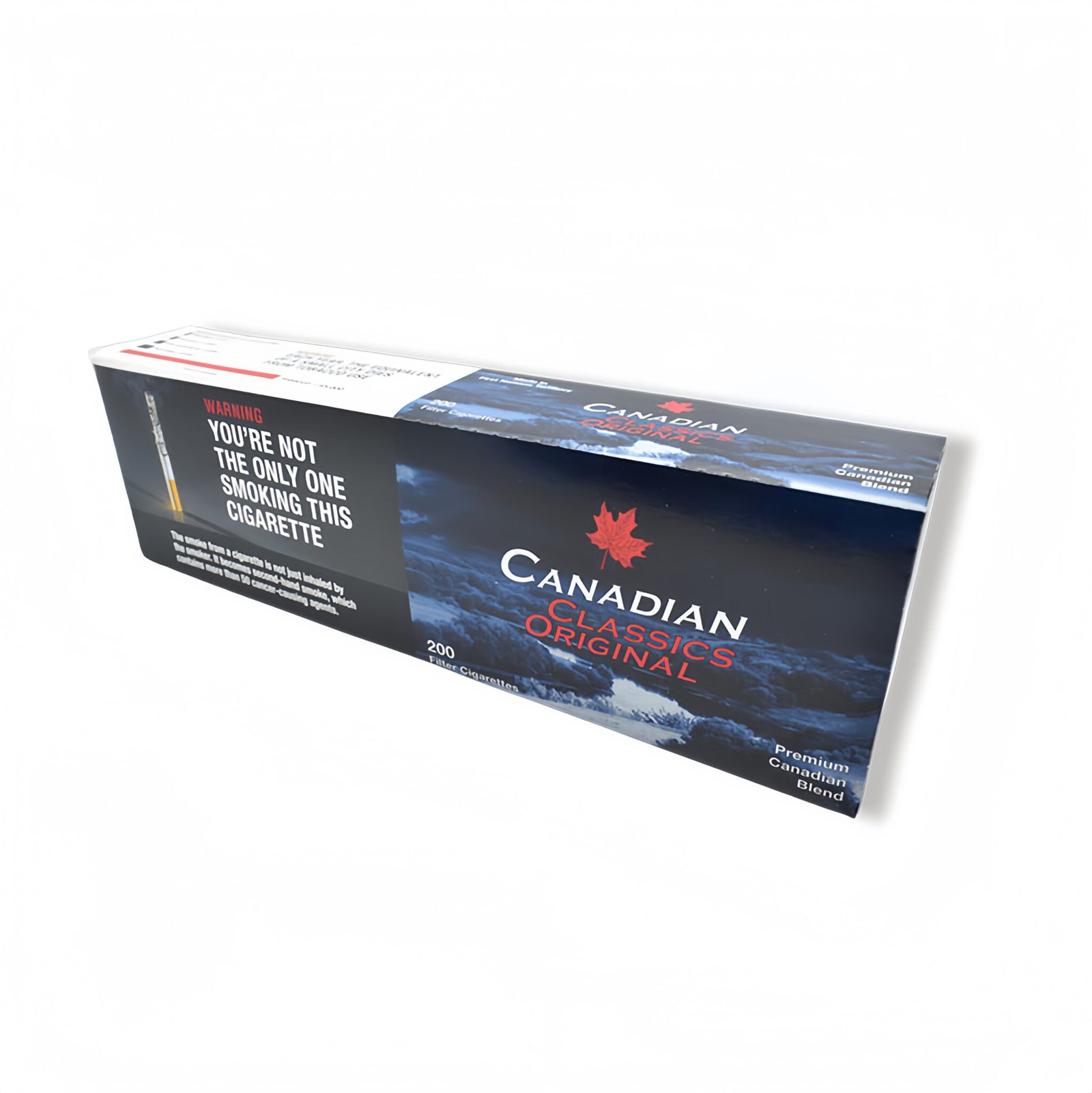
As a reference point, popular Canadian-market packs such as Canadian Classics Original (20/Pack) are listed online for around $24.99 compared with regular prices near $55 for some premium equivalents, while king-size 25s typically range from $28.99 to $32. Smokers who prefer a cooler finish can also compare menthol cigarettes alongside full flavour, light, and ultra light options to find the right balance of taste and price.
Tips for Canadian Smokers Looking to Spend Less
- Buy cartons instead of single packs. Per-pack savings of $1 to $2 are common at carton pricing.
- Compare brands within your preferred strength. Light, full flavour, and ultra light lines often have both premium and value options at very different prices.
- Watch for bundle deals. Multi-carton offers such as a Mix & Match 50-carton bundle can bring the effective cost per carton down considerably for households with more than one smoker.
- Check that packs carry the proper excise stamp. Legitimate products sold in Canada display a federal or provincial Canadian tobacco excise stamp.
- Track annual tax changes. Federal excise is adjusted every April 1, and provinces frequently announce increases in spring budgets, so prices rarely stay flat for long.
Buying Cigarettes Online in Canada
Online ordering has become a popular alternative for Canadians who want to compare prices across many brands without driving from store to store. SmokeKing is a trusted online smoke shop serving customers across Canada with a wide selection of quality cigarette and tobacco products, offering a convenient way to explore different brands, place orders securely, and receive products through reliable delivery services. Age verification requirements apply to all tobacco purchases in Canada, online or in person.
Frequently Asked Questions
What is the cheapest province to buy cigarettes in Canada?
Quebec has the lowest cigarette prices in Canada, with a pack of 20 averaging $12 to $14 thanks to the country’s lowest provincial tobacco tax rate.
Why are cigarettes so expensive in Canada?
High federal excise duty, provincial tobacco taxes, and sales taxes together make up more than half of the retail price. Governments use these taxes deliberately as part of smoking statistics Canada targets to reduce tobacco use.
How much does a pack of 25 cigarettes cost in Canada?
King-size packs of 25 typically cost $15 to $17 in Quebec, $19 to $21 in Ontario, and $21 to $24 in higher-tax provinces and the territories.
Will cigarette prices in Canada go up again?
Almost certainly. Federal excise duty is indexed to inflation every April, and most provinces have raised tobacco taxes at least once in the past several years. Canadian smokers should expect gradual increases to continue.
Whether you pay $12 in Montreal or $22 in Yellowknife, understanding how taxes build up the price of a pack helps you make informed choices about what, where, and how you buy. Comparing brands, buying in larger quantities, and keeping an eye on annual tax changes remain the most practical ways for Canadian smokers to manage the rising cost of cigarettes.